

Introduction
A maintenance schedule gives businesses a clear system for deciding when equipment and facility systems should be inspected, serviced, tested, or repaired. Without proper scheduling, important maintenance tasks can easily be delayed because of busy operations or changing business priorities.
This can become a serious issue when a company manages multiple systems across a commercial property. HVAC units, electrical installations, generators, pumps, plumbing equipment, machinery, and other assets may all require different levels of attention.
An annual maintenance contract can help businesses organize these responsibilities by establishing planned service visits and defining the maintenance activities that should be completed throughout the year.
Begin With a Complete Facility Assessment
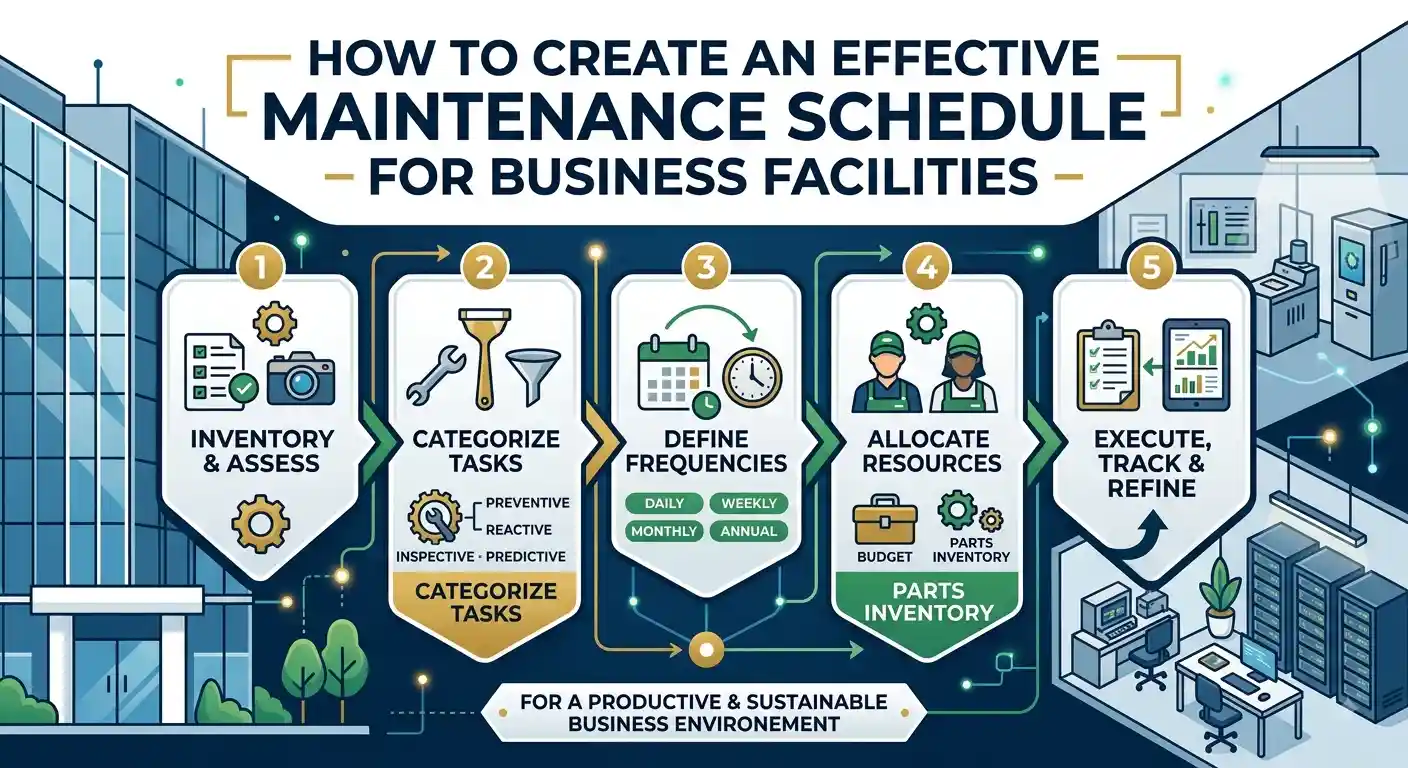
Before creating a schedule, businesses should understand what is installed within the facility.
A complete assessment can identify the equipment, systems, locations, operating conditions, and current condition of important assets.
This information creates the foundation for a practical maintenance plan.

Without an accurate equipment inventory, businesses may accidentally overlook systems that require periodic servicing.
Rank Systems According to Risk
Every asset does not need the same maintenance priority.
A business should consider what would happen if a particular system failed.
Equipment that could stop production, affect customers, damage property, or create significant operational disruption should generally receive greater attention.
Lower-risk assets can often be scheduled at less frequent intervals.
This risk-based approach helps businesses use maintenance resources efficiently.
Use Manufacturer Recommendations as a Starting Point
Equipment manufacturers often provide guidance regarding inspections and servicing.
These recommendations can help businesses establish initial maintenance intervals.
However, actual operating conditions may require adjustments.
Equipment used continuously, exposed to harsh environments, or operating under heavy loads may need more frequent attention than equipment operating under normal conditions.
Maintenance schedules should therefore consider both manufacturer guidance and real-world usage.
Divide Tasks by Frequency
A practical schedule can separate maintenance activities according to how often they need to be completed.
Some checks may be appropriate on a monthly basis, while others may occur quarterly, semi-annually, or annually.
The exact frequency depends on the type of equipment and operating environment.
Organizing tasks in this way makes the schedule easier to manage and reduces the chance that important activities will be forgotten.
Plan Around Business Hours
Maintenance should not unnecessarily interfere with normal business operations.
Companies can coordinate routine service visits during quieter periods whenever possible.
Retail businesses may prefer work before opening or after closing, while factories may schedule certain maintenance activities during planned production breaks.
The maintenance schedule should reflect these operational requirements.
Keep Critical Equipment Available
Some systems should have minimal interruption because they are essential to business continuity.
For these assets, maintenance may need to be performed during carefully planned service windows.
The provider and business should agree on suitable timing so that necessary maintenance can be completed without creating avoidable operational problems.
An annual maintenance contract can help establish recurring service windows in advance.
Include Preventive Inspections
A good schedule should not focus only on cleaning or routine servicing.
Inspections are equally important because they provide an opportunity to identify developing problems.
Technicians may look for unusual sounds, leaks, overheating, wear, corrosion, damaged components, or other warning signs.
Identifying these conditions early can allow businesses to address them before they result in major disruption.
Schedule Seasonal Maintenance
Some equipment has greater importance during particular times of the year.
Cooling systems, for example, may experience higher demand during hot weather. Heating equipment may become more important during colder periods.
Businesses should arrange appropriate inspections before periods of peak demand.
Seasonal servicing can help identify potential problems before equipment is placed under increased operating pressure.
Include Emergency Procedures
A maintenance schedule cannot prevent every unexpected failure.
Businesses should therefore have a clear procedure for dealing with emergencies.
Employees should know how to report faults, who should be contacted, and what information should be provided.
The maintenance provider should also explain its response process for urgent requests.
For critical facilities, emergency arrangements should be documented rather than left to informal communication.
Record Every Service Visit
Maintenance scheduling becomes much more effective when every completed activity is documented.
Service records should show the date of the visit, equipment inspected, work performed, faults identified, parts replaced, and recommendations provided.
These records can be used to confirm that scheduled tasks have been completed and to identify patterns over time.
Track Missed or Delayed Maintenance
Sometimes a scheduled maintenance task cannot be completed on time.
Equipment may be unavailable, access may be restricted, or business operations may require the visit to be postponed.
These changes should be recorded and rescheduled rather than forgotten.
A maintenance management process should make it easy to identify outstanding tasks.
Review Recurring Faults
A schedule should evolve according to what the maintenance records reveal.
If a particular system repeatedly develops the same problem, the maintenance frequency may need to be increased.
Alternatively, the business may need a more comprehensive repair or equipment replacement.
Regular review prevents the maintenance schedule from becoming a static document that no longer reflects actual equipment conditions.
Use Maintenance Reports for Future Planning
Service reports provide more than evidence of completed work.
They can also help management understand how assets are performing.
Repeated repairs, increasing downtime, or declining equipment performance may indicate that an asset is approaching the end of its useful life.
This information can support future budgeting and replacement planning.
Coordinate Different Maintenance Providers
Some businesses use separate specialists for different systems.
For example, HVAC, electrical, fire safety, elevators, and specialized machinery may each have their own service providers.
When multiple contractors are involved, businesses should coordinate schedules carefully.
A centralized maintenance calendar can help prevent overlapping visits and ensure that important tasks are not missed.
Review the Schedule Periodically
A maintenance schedule should be reviewed throughout the year.
Changes in equipment, business hours, facility size, operating conditions, or production levels may require adjustments.
Management can use service records and equipment performance information to determine whether the current schedule remains appropriate.
An annual maintenance contract should also be reviewed against actual service requirements to ensure that the contracted scope continues to match the business.
What a Good Maintenance Plan Should Achieve
The purpose of scheduling is not to perform as many maintenance tasks as possible.
The goal is to maintain important assets at appropriate intervals while minimizing unnecessary disruption and expense.
A good plan should make responsibilities clear, prioritize critical equipment, support preventive care, and provide useful records for future decisions.
It should also be flexible enough to change when equipment or business conditions change.
Choosing a Provider That Can Follow the Schedule
A detailed maintenance plan is only useful if the service provider can deliver it consistently.
Businesses should evaluate technician availability, response times, technical expertise, reporting procedures, and communication.
The provider should also be able to explain how missed visits, urgent requests, and additional maintenance requirements are handled.
An annual maintenance contract is most useful when the provider has the resources and expertise needed to follow the agreed schedule.
Final Thoughts
A well-organized maintenance schedule can help businesses manage equipment more consistently and reduce the risk of important servicing tasks being forgotten. By identifying critical assets, setting appropriate intervals, coordinating service visits, and keeping accurate records, companies can create a more reliable approach to facility maintenance.
An annual maintenance contract can provide the structure needed to maintain this routine throughout the year. However, the agreement should be customized according to the company’s equipment, operating environment, service requirements, and business priorities.
The most effective maintenance strategy is not simply about following a calendar. It is about using equipment information, service history, and operational needs to determine what should be maintained, when it should be maintained, and how potential problems should be handled.
With consistent scheduling and professional support, businesses can better protect their facilities, manage maintenance responsibilities, and support reliable day-to-day operations.
Related Reading: O General AC Supplier Guide for Home and Business Owners