
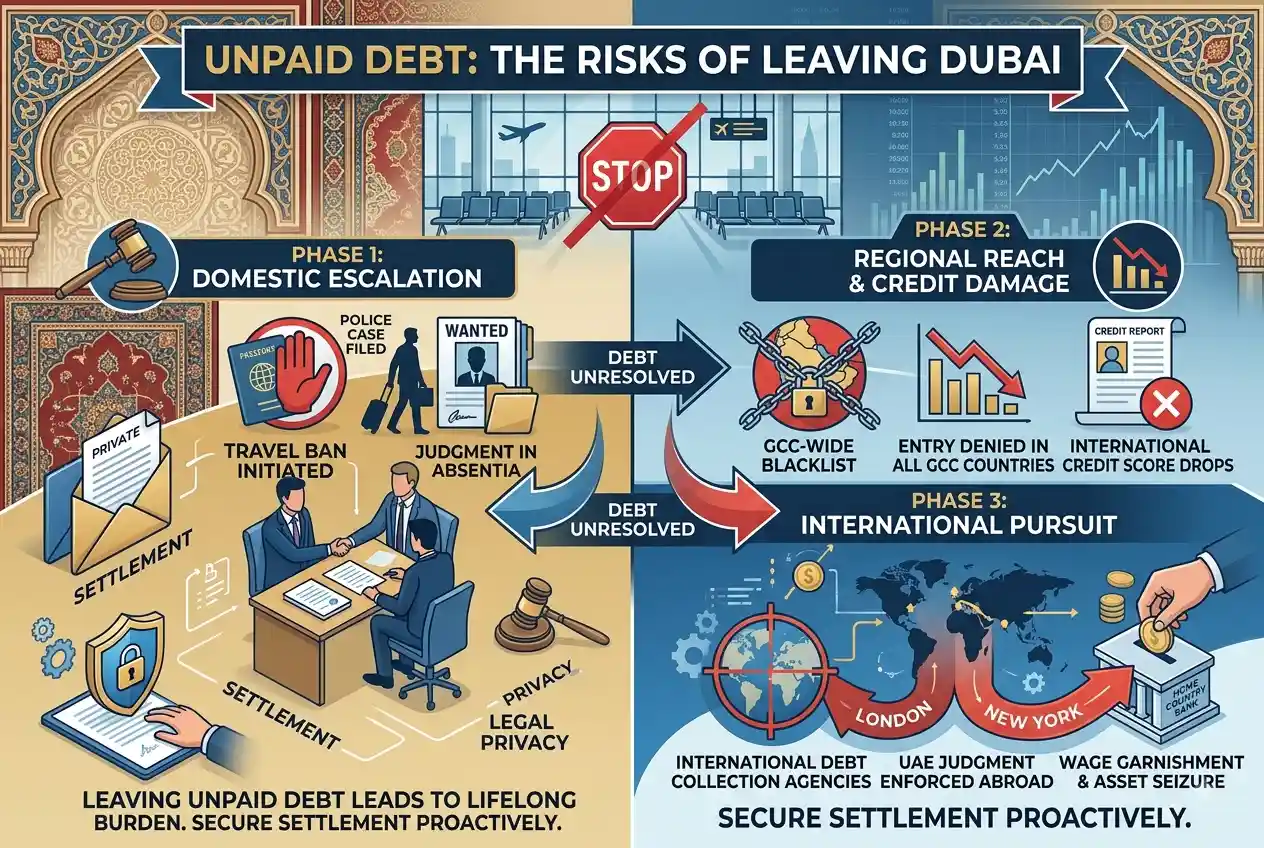

Leaving Dubai while having unpaid debt does not automatically cancel or eliminate the debt. Whether you are a UAE resident, expatriate employee, business owner, or visitor, outstanding financial obligations can continue after you leave the country. Creditors, banks, finance companies, landlords, and other parties may have legal options to pursue repayment, depending on the nature of the debt and the circumstances of the case.
For this reason, anyone planning to leave Dubai with unpaid financial obligations should understand the possible consequences and consider obtaining appropriate legal advice. A professional Debt Collection Dubai service or lawyer can help assess the debt, communicate with creditors, and determine what lawful recovery options may be available.
Does Leaving Dubai Cancel an Unpaid Debt?
No. Leaving Dubai generally does not make an outstanding debt disappear. A debt remains a financial obligation unless it is paid, settled, legally discharged, or otherwise resolved.
For example, a person may leave the UAE while owing money on:
- Personal loans
- Credit cards
- Business financing
- Rent or other contractual obligations
- Unpaid invoices
- Trade debts
- Commercial loans
- Supplier accounts
- Other contractual liabilities
A creditor may continue attempting to recover the amount after the debtor has left the UAE. Depending on the circumstances, the creditor may also pursue legal proceedings.

This is one reason why Debt Collection Dubai matters even when the debtor is no longer physically present in Dubai. Debt recovery is not necessarily limited to contacting someone at their former UAE address.
Can a Bank Pursue Me After I Leave Dubai?
Potentially, yes. Leaving the UAE does not necessarily prevent a bank or financial institution from taking legal action regarding an unpaid loan or credit-card balance.
The exact consequences depend on factors such as:
- The amount outstanding
- The contractual terms
- The type of financial facility
- Whether payments have defaulted
- Whether legal proceedings have already started
- Whether there are guarantees or security
- Whether there are assets or income available for enforcement
- The debtor’s location after leaving the UAE
A bank may first attempt to recover the outstanding amount through communication, payment demands, restructuring, or settlement discussions. If those efforts fail, legal remedies may become relevant.
A Debt Collection Dubai professional can help determine whether negotiation, settlement, or formal legal proceedings are appropriate.
Can I Be Stopped at the Dubai Airport Because of Debt?
This depends on whether any applicable travel restriction or other legal measure has been issued.
An unpaid debt by itself should not be treated as an automatic guarantee that someone will be stopped at the airport. However, certain legal proceedings can result in measures that affect a person’s ability to travel.
This distinction is important.
Someone who simply has an unpaid invoice is in a different situation from someone who is already subject to court proceedings or a legally imposed travel restriction.
Before travelling, a person who knows that a serious debt dispute exists should consider checking their legal position and obtaining professional advice. This can help identify whether any proceedings or restrictions require attention.
What If I Leave Before the Creditor Takes Legal Action?
Leaving before legal proceedings begin does not necessarily prevent the creditor from starting a case later.
For example, suppose someone owes a significant amount to a Dubai-based company and leaves the UAE without settling the account. The creditor may subsequently consider available legal avenues for recovering the amount.
The creditor may also continue sending payment demands or negotiate with the debtor remotely.
This is why ignoring communications after leaving Dubai is generally not a good strategy. A person who receives a formal demand or legal notice should understand what it means and respond appropriately rather than assuming that being outside the UAE makes the matter irrelevant.
Can Debt Collection Dubai Agencies Contact Me Overseas?
They may attempt to contact a debtor who has moved outside the UAE, provided that their collection activities comply with applicable laws.
Communication may involve:
- Telephone
- Written correspondence
- Settlement proposals
- Payment requests
- Legal representatives
- Other lawful communication channels
The fact that the debtor is living abroad can make recovery more complicated, but it does not necessarily make recovery impossible.
In international situations, creditors may need to consider the laws of the jurisdiction where the debtor is located and whether a UAE judgment or other legal instrument can be recognized or enforced there.
Can a Dubai Debt Be Recovered in Another Country?
Possibly. International debt recovery depends heavily on the countries involved, the nature of the debt, the available legal documents, and the enforcement laws of the country where the debtor is located.
A creditor may need to obtain a judgment or other enforceable instrument before seeking recognition or enforcement in another jurisdiction.
The process can involve additional legal requirements, costs, documentation, and procedural steps.
For businesses, international debt recovery can become particularly complex when a debtor, creditor, contract, assets, and bank accounts are located in different countries. In such situations, experienced Debt Collection Dubai professionals may coordinate with lawyers or recovery professionals in the relevant foreign jurisdiction.
What Happens to My Credit History?
Leaving Dubai does not necessarily erase the financial history associated with unpaid debts.
Unpaid loans, credit-card balances, and other defaults may have consequences for a person’s financial profile in the UAE. The practical impact depends on the type of debt, reporting arrangements, the financial institution involved, and applicable regulations.
A person who intends to return to the UAE in the future should therefore avoid assuming that leaving the country permanently resolves the problem.
Before departure, it may be preferable to contact the creditor and discuss:
- Full repayment
- A payment plan
- Restructuring
- Settlement
- Early repayment arrangements
- Documentation confirming the resolution
Obtaining written confirmation of a settlement or payment can also be important for future reference.
Can a Creditor Recover Money From My UAE Assets?
Potentially, depending on the legal status of the debt and any court proceedings.
If a debtor has assets in the UAE, those assets may become relevant to lawful enforcement proceedings where the creditor obtains the necessary legal authority.
Examples can include certain:
- Bank balances
- Business interests
- Receivables
- Property interests
- Other assets
The precise enforcement mechanisms depend on the applicable law and the nature of the judgment or claim.
This is why debtors should not assume that leaving Dubai means UAE-based assets are automatically protected from recovery efforts.
What If I Owe Money to a Business Supplier?
Commercial debt can create additional complications.
Suppose a company owner leaves Dubai while their company owes money to suppliers. Whether the individual is personally responsible depends on the company’s structure, contractual arrangements, guarantees, personal undertakings, and other circumstances.
A company debt is not automatically the personal debt of every shareholder or manager. However, personal guarantees or other contractual obligations can change the situation.
For businesses, early involvement of a Debt Collection Dubai professional can help establish:
- Who legally owes the money.
- What documents establish the debt.
- Whether the amount is disputed.
- Whether a settlement is possible.
- What legal recovery options may exist.
What If the Debt Is Disputed?
Not every unpaid amount is an undisputed debt.
A person may believe that:
- The amount is incorrect.
- The goods or services were defective.
- The contract was terminated.
- Payment has already been made.
- Interest or charges were incorrectly calculated.
- The creditor breached the agreement.
- The invoice was issued incorrectly.
In such circumstances, simply refusing to pay may not be the best approach. The underlying contractual and documentary evidence should be reviewed.
A Debt Collection Dubai lawyer or qualified legal professional can help determine whether the issue is genuinely a debt or a broader contractual dispute.
Should I Contact My Creditor Before Leaving Dubai?
In many circumstances, communicating with the creditor before leaving can be beneficial.
Instead of disappearing, a debtor can explain their circumstances and ask whether the creditor is willing to consider a repayment arrangement or settlement.
Depending on the situation, possible solutions could include:
- Paying the full balance
- Negotiating a reduced settlement
- Establishing monthly instalments
- Restructuring the facility
- Agreeing on a payment deadline
- Resolving a disputed amount
Any agreement should preferably be documented clearly. The debtor should retain receipts, settlement agreements, correspondence, and evidence of payments.
What If I Cannot Afford to Pay the Entire Debt?
Financial difficulty does not necessarily mean that the only option is to ignore the creditor.
A person may be able to negotiate a structured repayment arrangement. Whether the creditor accepts such an arrangement is a matter of the particular circumstances.
When negotiating, it is useful to understand:
- The total principal outstanding
- Applicable contractual charges
- Amounts already paid
- The proposed settlement amount
- Payment deadlines
- Consequences of missing instalments
- Whether the creditor will provide written confirmation after settlement
Professional assistance can sometimes make negotiations more organized, particularly where multiple debts are involved.
Can Debt Collection Dubai Help After I Have Left the UAE?
Yes, debt recovery work can involve parties who are outside Dubai. The appropriate approach depends on the debt and the debtor’s location.
A Debt Collection Dubai agency or legal professional may assist with matters such as:
- Reviewing debt documentation
- Contacting the debtor
- Sending formal payment demands
- Negotiating settlements
- Developing repayment arrangements
- Coordinating legal proceedings
- Assisting with commercial debt recovery
- Working with overseas legal professionals when appropriate
However, debt collection must be conducted lawfully. A legitimate recovery process should not involve harassment, threats, unlawful disclosure of personal information, or other prohibited conduct.
What Should I Do Before Leaving Dubai With Debt?
If you know you have unpaid debt and are planning to leave Dubai, taking proactive steps is generally safer than simply ignoring the issue.
Consider the following:
- Identify all outstanding debts.
Prepare a list of loans, credit cards, rent, business liabilities, invoices, and other obligations. - Check the amounts.
Make sure you understand how much is actually outstanding and whether there are disputed charges. - Contact the relevant creditors.
Ask whether repayment, restructuring, or settlement options are available. - Obtain written agreements.
Do not rely solely on verbal promises. - Keep payment evidence.
Retain receipts, bank confirmations, settlement documents, and correspondence. - Seek legal advice where necessary.
This is particularly important if you have received a formal legal notice or believe proceedings may already exist. - Check your legal position before travelling.
If there is a serious dispute or ongoing legal matter, professional advice can help clarify whether any restrictions or proceedings may affect you.
Final Thoughts
Leaving Dubai does not automatically eliminate unpaid debt. Depending on the circumstances, creditors may continue recovery efforts, commence legal proceedings, pursue available enforcement mechanisms, or explore lawful options involving the debtor’s assets or location outside the UAE.
The consequences depend on the type of debt, contractual documents, amount owed, legal proceedings, guarantees, available assets, and the country where the debtor subsequently lives. Therefore, there is no single consequence that applies to every person who leaves Dubai with unpaid debt.
If you are dealing with outstanding personal or commercial liabilities, obtaining advice from an experienced Debt Collection Dubai professional can help you understand your options and potentially resolve the matter through repayment or negotiated settlement before it becomes more complicated.
Related Reading: Fast Pod Delivery Across Dubai, Sharjah and Ajman
Related Reading: Can Bank Accounts Be Frozen in Debt Collection Cases in Dubai