
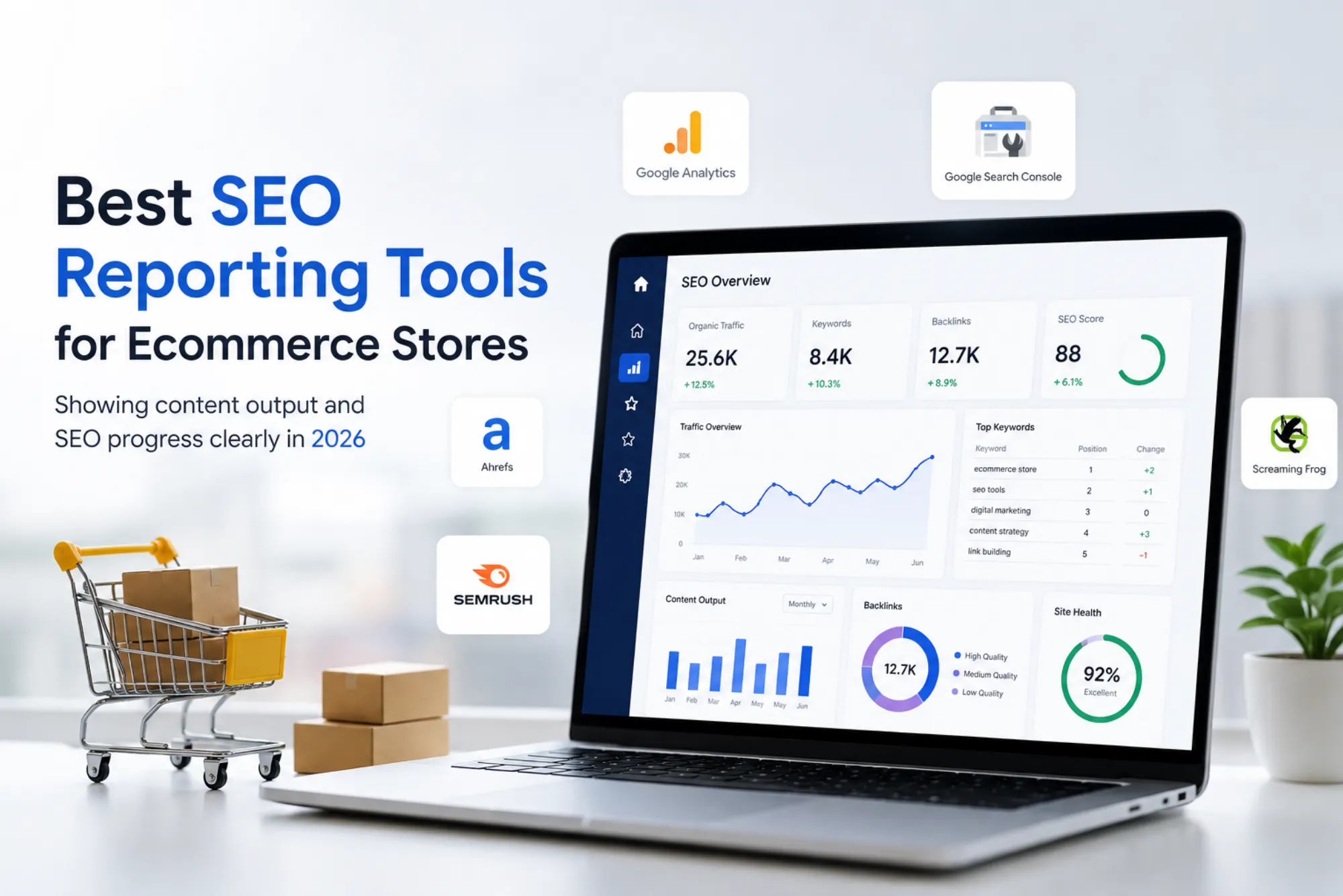

SEO reporting has evolved far beyond basic keyword ranking charts. Ecommerce businesses in 2026 need tools that clearly show how content performs, how technical improvements affect visibility, and how organic search contributes directly to revenue growth.
The best SEO reporting tools for ecommerce stores now combine keyword monitoring, content performance analytics, conversion tracking, technical diagnostics, and actionable reporting dashboards. Choosing the right platform helps store owners understand what is working, where traffic is being lost, and how to prioritize future optimization efforts.
Businesses that already invest in digital visibility often combine strong reporting frameworks with broader optimization strategies such as professional website design improvements and scalable content publishing systems to maintain long-term search growth.
SEO Snapshot: What Ecommerce Stores Need in 2026
The ideal SEO reporting tool should provide a clear picture of performance across multiple metrics. Modern ecommerce reporting must answer practical business questions:
- Which product and category pages are growing organically?
- Which content assets are generating conversions?
- Where are ranking losses occurring?
- What technical issues are hurting visibility?
- How does SEO performance connect to revenue?
| Reporting Requirement | Why It Matters | Business Impact |
|---|---|---|
| Keyword Tracking | Measures search visibility trends | Improves ranking strategy |
| Content Performance Reports | Shows page-level engagement | Optimizes content ROI |
| Technical SEO Monitoring | Detects crawl and indexing issues | Protects search performance |
| Revenue Attribution | Connects traffic to sales | Measures SEO profitability |
| Automated Dashboards | Saves reporting time | Supports faster decision-making |
Top SEO Reporting Tools for Ecommerce Stores in 2026
1. Ahrefs
Ahrefs remains one of the most comprehensive ecommerce SEO reporting platforms available. Its strength lies in backlink intelligence, keyword movement tracking, and detailed page-level performance reporting.
For ecommerce teams managing hundreds or thousands of product pages, Ahrefs offers exceptional visibility into ranking trends and competitor movement.

Key advantages include:
- Organic traffic estimation
- Content gap analysis
- Historical keyword performance tracking
- Automated alerts for ranking fluctuations
Its content reporting interface also helps identify underperforming pages that may need updates, consolidation, or technical fixes.
2. SEMrush
SEMrush continues to lead as a complete ecommerce SEO reporting ecosystem. Its reporting dashboards are especially useful for teams that need stakeholder-friendly visualization.
The platform combines:
- Position tracking
- Site health reports
- Content audit tools
- Competitor benchmarking
- Custom PDF reporting
Stores investing in broader digital visibility often align SEO reporting with strategic digital expansion, similar to businesses building online authority through guest posting initiatives.
3. Google Search Console + Looker Studio
This remains one of the most cost-effective combinations for ecommerce reporting.
Google Search Console provides raw search performance data, while Looker Studio transforms that information into visually clear dashboards.
This setup works especially well for businesses needing:
- Custom reporting flexibility
- Direct search query insights
- Impression-to-click trend analysis
- Page indexing visibility
Official reporting frameworks and implementation best practices can often be supplemented through trusted SEO documentation and technical references at [Insert relevant reference link here].
4. Screaming Frog with Reporting Integrations
Screaming Frog excels at technical SEO diagnostics and large-scale ecommerce site auditing.
Its scheduled crawl reporting helps monitor:
- Broken internal links
- Redirect chains
- Duplicate metadata
- Indexability issues
- Structured data errors
For ecommerce stores with large product catalogs, this technical reporting visibility is essential.
5. Surfer SEO
Surfer SEO has become increasingly valuable for content performance reporting. While it is often known for content optimization, its reporting capabilities now help ecommerce content teams track page improvements after optimization updates.
This is particularly useful for category pages, buying guides, and educational commerce content.
How to Evaluate SEO Reporting Tools for Ecommerce Stores
Not every reporting platform fits every ecommerce business. Selection depends on operational scale, reporting maturity, and business goals.
| Store Type | Recommended Tool | Best Use Case |
|---|---|---|
| Small Ecommerce Store | Search Console + Looker Studio | Affordable reporting |
| Mid-Sized Growth Store | SEMrush | Balanced reporting and optimization |
| Enterprise Ecommerce | Ahrefs + Screaming Frog | Large-scale performance monitoring |
| Content-Driven Commerce Brand | Surfer SEO | Content optimization reporting |
Features That Matter Most in 2026
Revenue Attribution Reporting
Traffic growth alone is no longer enough. The strongest ecommerce SEO tools show how organic sessions contribute directly to purchases, average order value, and customer acquisition.
AI-Powered Opportunity Detection
Modern platforms now identify ranking opportunities automatically by analyzing SERP gaps, content weaknesses, and competitor gains.
Visual Content Performance Tracking
Clear dashboards showing page-level content output and performance progression are essential for strategic decision-making.
This reporting clarity mirrors the importance of structured analytics across all online business functions, much like organizations evaluating long-term growth opportunities through resources discussing digital marketing strategy development.
Common SEO Reporting Mistakes Ecommerce Stores Make
Even with powerful tools, reporting mistakes can limit results.
- Tracking vanity metrics without conversion context
- Ignoring category-level reporting
- Overlooking technical crawl reports
- Reporting too infrequently
- Failing to benchmark against competitors
The best reporting systems prioritize business-impact metrics rather than surface-level visibility indicators.
Building a Practical Ecommerce SEO Reporting Workflow
A strong reporting framework usually follows this process:
- Collect ranking and technical data weekly
- Review content performance monthly
- Analyze conversion attribution quarterly
- Prioritize fixes based on revenue impact
- Document trend patterns for future optimization
Stores that consistently refine workflows often learn from operational efficiency principles seen across digital publishing ecosystems such as those shared on technology and IT strategy resources.
Frequently Asked Questions
Which SEO reporting tool is best for small ecommerce stores?
Google Search Console paired with Looker Studio offers excellent reporting capabilities with minimal cost and high customization flexibility.
Do ecommerce stores need paid SEO reporting tools?
Paid tools become valuable when stores need advanced competitor tracking, automation, technical diagnostics, and large-scale reporting efficiency.
How often should ecommerce SEO reports be reviewed?
Weekly ranking checks and monthly performance reviews provide the right balance for most ecommerce operations.
Can SEO reporting tools track product page performance?
Yes. Most advanced platforms provide page-level reporting for product pages, category pages, and informational content assets.
Final Thoughts
The best SEO reporting tools for ecommerce stores in 2026 are those that transform raw search data into clear business insights.
Whether using enterprise-level platforms like Ahrefs and SEMrush or building custom dashboards with Search Console and Looker Studio, the goal remains the same: making SEO progress visible, measurable, and actionable.
Ecommerce businesses that prioritize transparent reporting gain a strategic advantage because they can connect optimization efforts directly to performance outcomes. Clear reporting turns SEO from a vague marketing activity into a measurable growth engine.
Related Reading: Best SEO Audit Tools for Ecommerce Stores that catch on-site issues before new content goes live in 2026